
 |
 |
2. Signal Processing
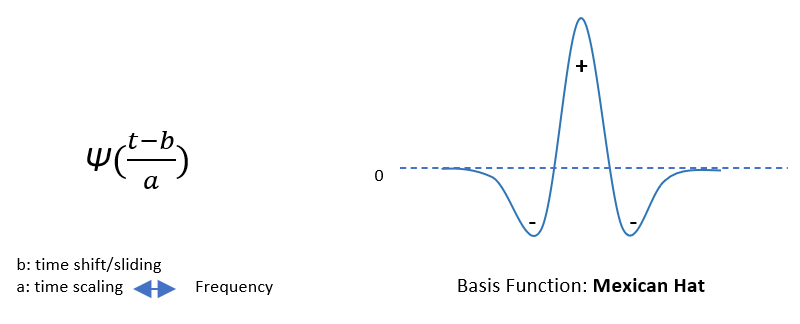
By utilizing this non-oscillatory, pulse-like waveform, the transform inherently varies its resolution, optimizing the capture of sudden localized events.
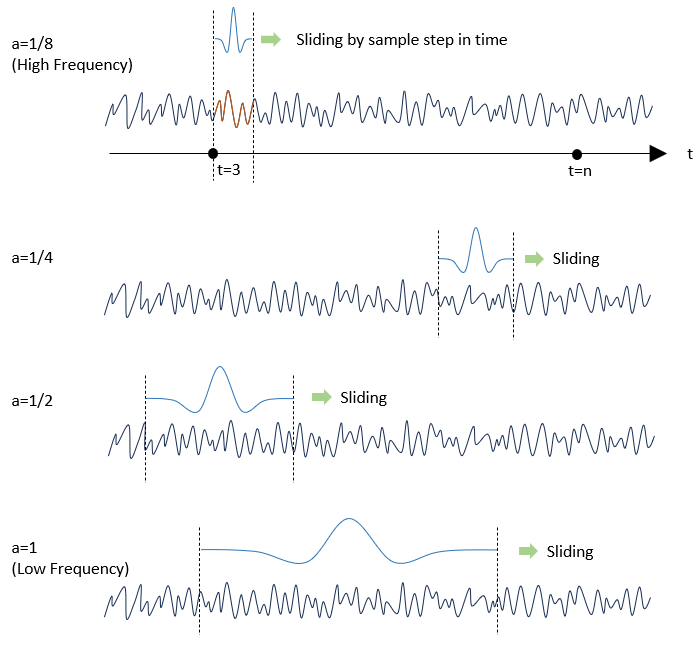
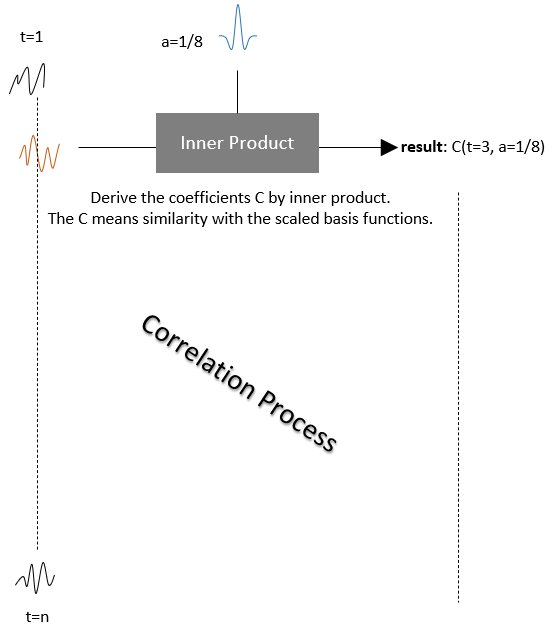
The Mexican Hat Wavelet operates by correlating the signal with scaled and shifted versions of the basis function.
By adjusting the scale and position of the wavelet, it extracts localized signal features, emphasizing local variations rather than repetitive, periodic signal patterns.
3. Representation
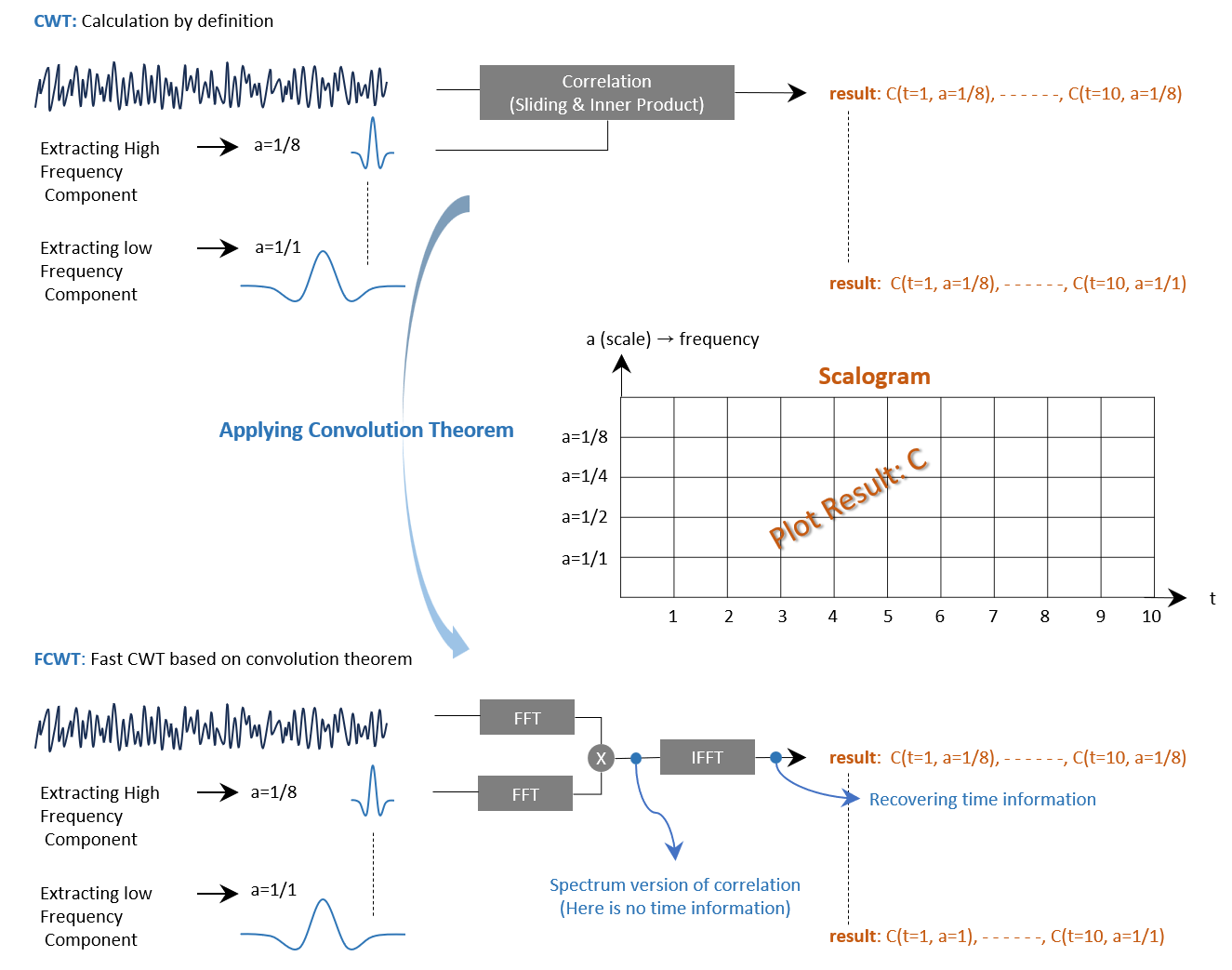
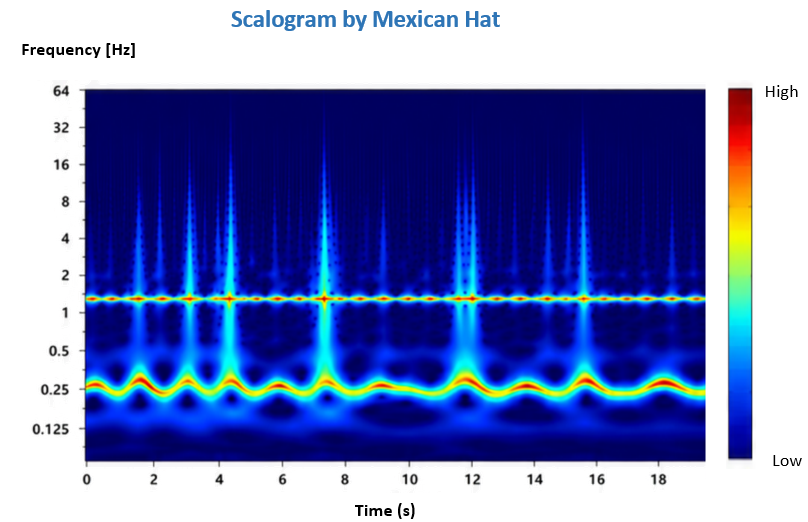
The result of the Mexican Hat Wavelet Transform is represented as a scalogram,
which shows the magnitude of signal components across time and scale.
The scale axis corresponds to different frequency ranges, while the magnitude highlights localized signal features.
4. Interpretation
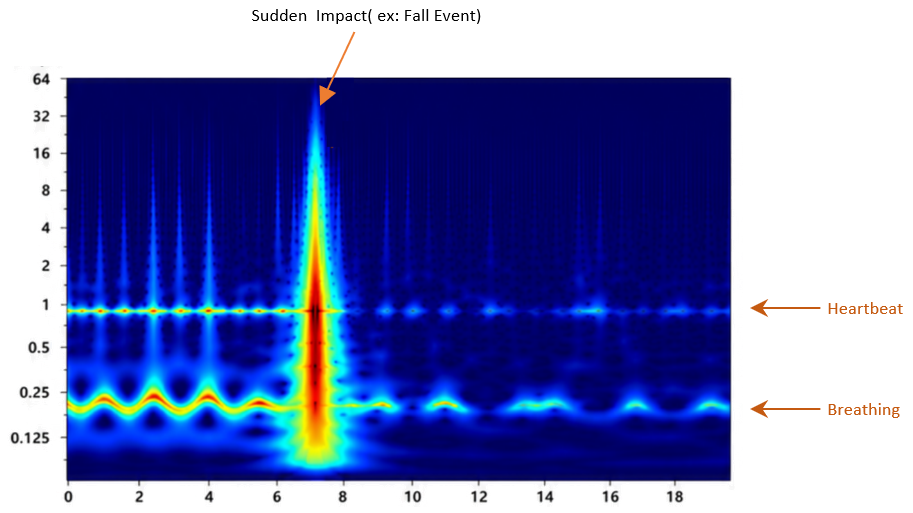
A strong high-intensity response appears around 7 s across a wide frequency range.
The simultaneous presence of both high-frequency and low-frequency components suggests that
the event contains sharp impact energy together with large-scale body motion and posture change, as observed during a sudden fall event.
5. Radar Application
Unlike the Morlet wavelet, which uses a sinusoidal basis, the Mexican Hat wavelet is based on a non-oscillatory Gaussian derivative function.
Therefore, its scale/frequency axis is more naturally interpreted in terms of transient duration and abruptness rather than precise oscillation frequency.
Smaller scales indicate sharper and faster changes, while larger scales represent broader and slower structures.
Compared to the Morlet wavelet, it is more sensitive to abrupt transient events but provides less detailed frequency information.
This is because the Mexican Hat transform measures similarity using a basis function whose shape itself resembles a sudden localized change.

Radar Sensor SoC & Module

WiFi IoT Module

5G/LTE/CAT-M1/NB-IoT

WiSUN/HaLow/Thread Module
