
Beamforming
Beamforming is a technique that utilizes the principle of wave interference
by controlling the relative phases of signals received from multiple antennas.
In radar systems, it is primarily used to estimate the target direction (θ) based on the phase difference (ΔΦ) between received signals.
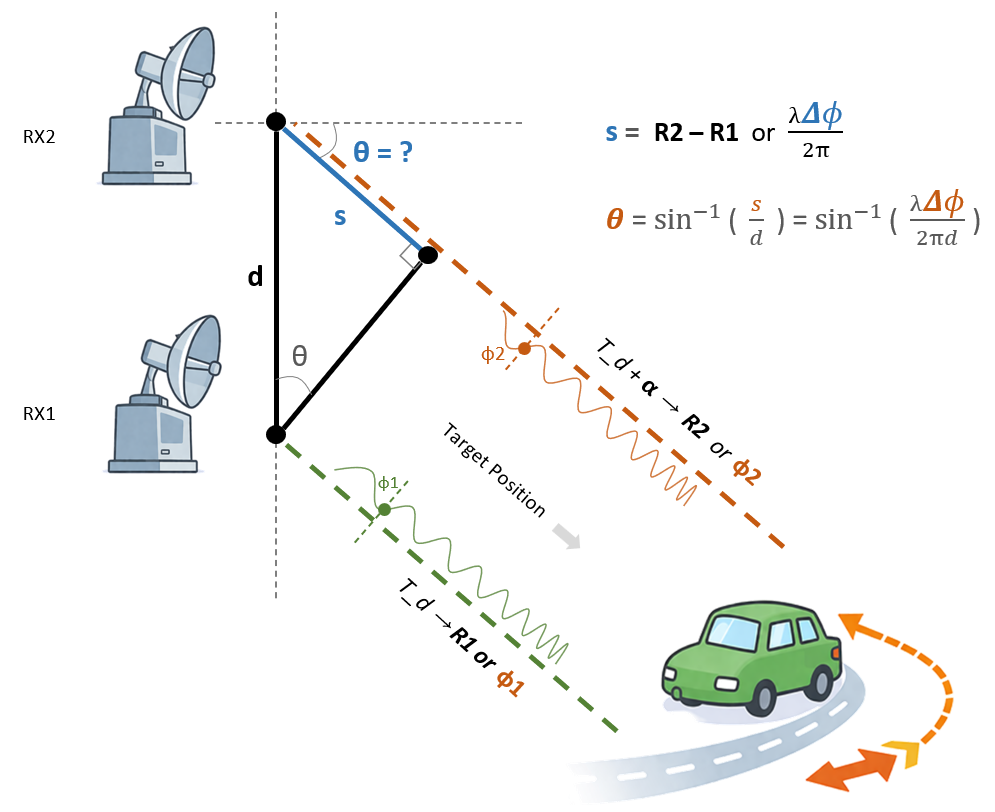
1. Scanning-Based Beamforming Mechanism
Through Phase-Scanning Beamforming, phases across the antenna array are aligned
to create constructive interference in a specific direction while inducing destructive interference in others.
The AoA is identified by finding the phase shift (delay) that maximizes signal amplitude, functioning as a spatial filter.
| Scanning: Varying the phase shift between RX signals | Interpretation | |
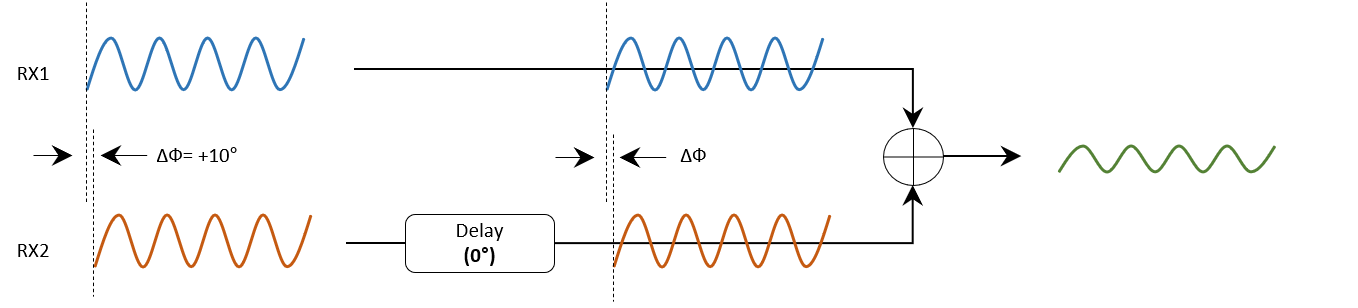 |
Without phase compensation, the received signals are used as-is, with no phase delay applied.
|
|
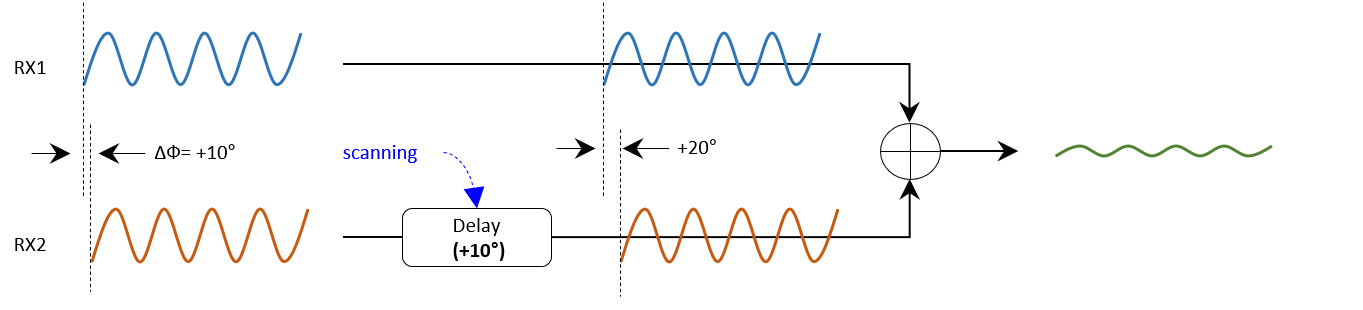 |
When the applied phase shift is incorrect, the signals become more out of phase,
increasing destructive interference and further reducing the combined amplitude. |
|
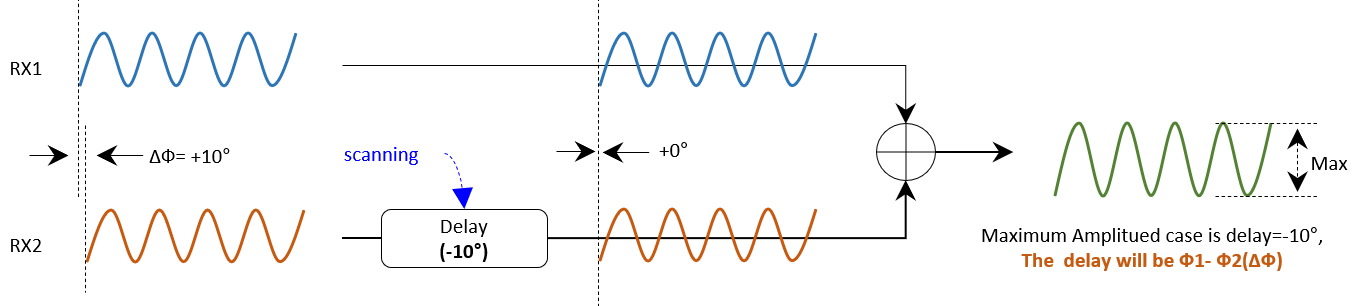 |
Proper phase compensation aligns the signals, resulting in maximum amplitude.
The applied phase shift equals the phase difference(ΔΦ= -10°). |
2. Practical Implementation
In practical implementations, beamforming is performed using digital signal processing (DSP), where received signals are converted into I/Q form.
A complex weight (phase shift) is applied to one of the signals to adjust the relative phase,
and the weighted signals are then combined to evaluate the resulting amplitude.
3. Additional Note: Beamforming in Transmission
Beamforming can be applied not only in reception but also in transmission,
where phase-controlled signals from multiple antennas are combined to focus energy toward a specific direction.

Radar Sensor SoC & Module

WiFi IoT Module

5G/LTE/CAT-M1/NB-IoT

WiSUN/HaLow/Thread Module
