
Doppler Effect → Velocity
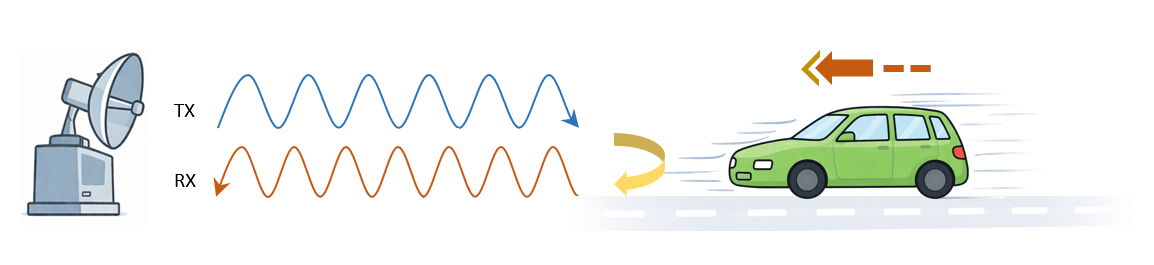
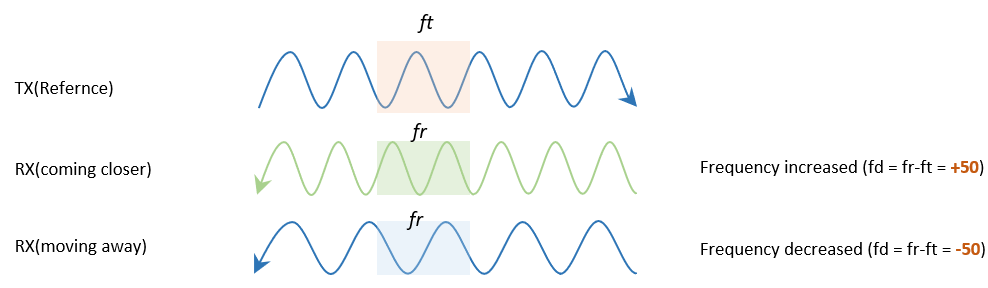
Reflected waves from a moving object experience a change in received frequency (Doppler Effect).
As the object comes closer, the frequency increases; as it moves away, the frequency decreases.
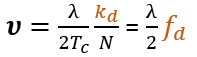
This frequency shift (Doppler shift) can be used to calculate the velocity.
|
|
||
1. Doppler Effect in Continuous Wave (CW)
A continuous sinusoidal signal with a fixed frequency is transmitted toward a target.
When the target is moving, the reflected signal exhibits a frequency shift proportional to its radial velocity.
This frequency difference is used to determine the target’s speed.
2. Doppler Effect in FMCW
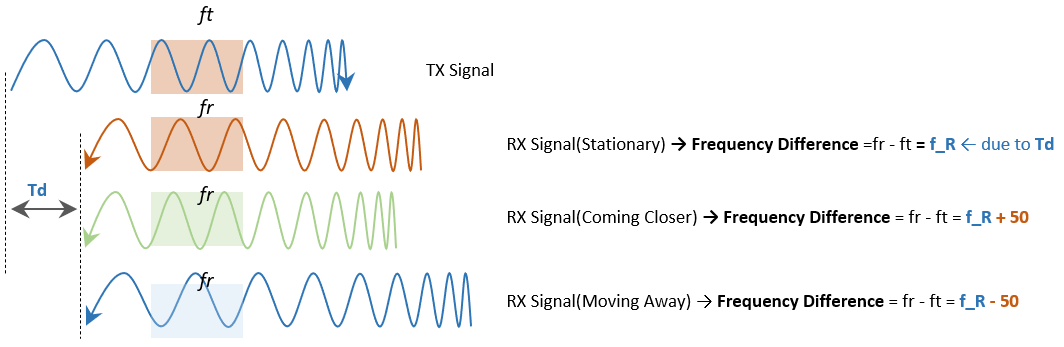
The extraction of the range-induced and Doppler-induced frequency components is described in the Range FFT and Doppler FFT sections of ANL.

Radar Sensor SoC & Module

WiFi IoT Module

5G/LTE/CAT-M1/NB-IoT

WiSUN/HaLow/Thread Module
