
Reflection / Absorption / Transmission
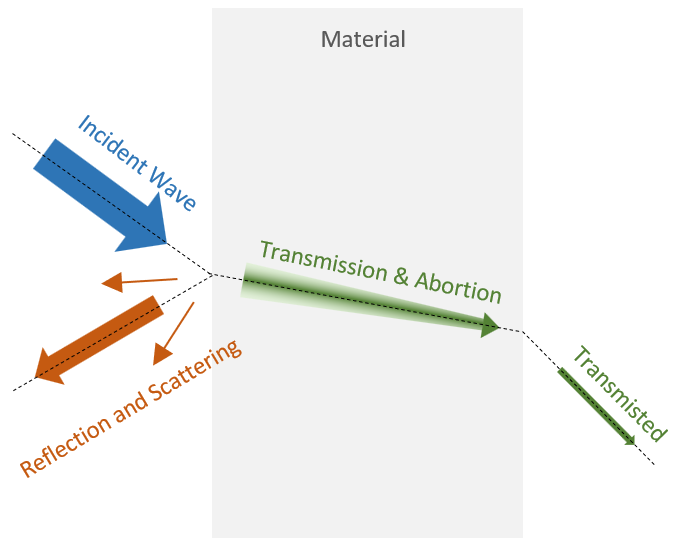
When electromagnetic waves encounter an object, the energy is partitioned into reflection, absorption, and transmission.
The distribution between these three depends on the signal’s frequency, as well as the material’s properties and thickness.
1. RCS (Radar Cross Section)
Among various electromagnetic phenomena, reflection and scattering are critical in radar systems, as they directly dictate the received signal power.
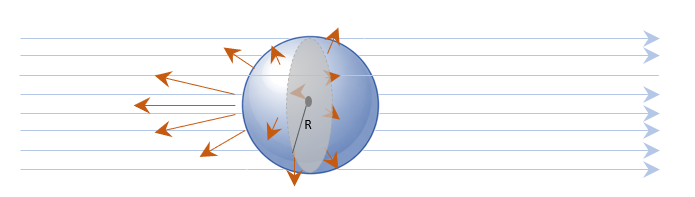
RCS quantifies this reflection as an equivalent area, including both specular reflection and scattering effects, and varies with shape, material, and incident angle.
It is defined with respect to an ideal isotropic scatterer, serving as a reference for comparing reflected power under the same conditions.
PEC Sphere Example
A PEC sphere is commonly used as a practical approximation for RCS analysis.
In the high-frequency region, its RCS approaches the projected (cross-sectional) area, πR².
2. RCS Comparison by Materials
This table presents typical RCS values for various materials and objects commonly found in a home environment.
A higher RCS value indicates a greater amount of reflected energy returned to the radar.
It is important to note that RCS is determined not only by the material’s reflectivity but also by the object’s physical dimensions and geometry.
| RCS Level | Material / Type | Examples | Typical RCS | Description | |
| Reference |
PEC Sphere (ideal conductor) |
Ideal metal sphere |
Depends on R σ ≈ πR² |
Used as a conceptual reference; RCS approaches projected area (πR²) in high-frequency region |
|
| High |
Metal (conductive objects) |
Refrigerator, washing machine, metal cabinet |
1 ~ 10 m² 0 ~ 10 dBsm |
Strong reflection due to high conductivity | |
| Medium |
Human Body (complex scatterer) |
Human |
0.5 ~ 1.5 m² −3 ~ 2 dBsm |
Irregular shape and internal structure produce complex scattering | |
| Medium-Low |
Water (high-loss dielectric) |
Water tank, wet surfaces, large plants |
0.2 ~ 1 m² −7 ~ 0 dBsm |
Strong dielectric response with partial absorption | |
| Low |
Wood / Plastic (dielectric) |
Table, chair, Furniture |
0.01 ~ 0.1 m² −20 ~ −10 dBsm |
Weak reflection | |
| Very Low | Fabric/Soft materials |
Curtain, clothes, bedding |
0.001 ~ 0.01 m² −30 ~ −20 dBsm |
Minimal reflection |

Radar Sensor SoC & Module

WiFi IoT Module

5G/LTE/CAT-M1/NB-IoT

WiSUN/HaLow/Thread Module
