
Maximum Range vs. Chirp-up Time
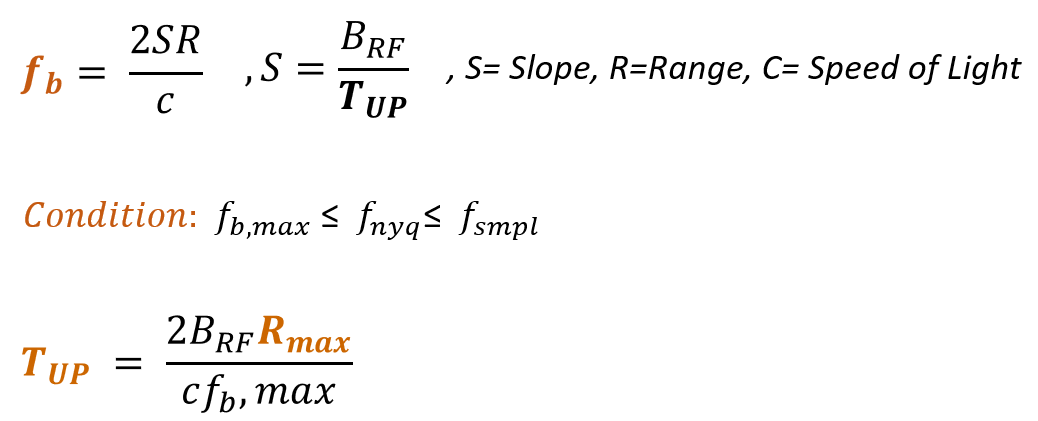
Increasing chirp-up-time, T_UP allows a longer maximum measurable range by reducing the beat frequency within ADC constraints.
 |
1. The relationship between chirp slope and T_UP
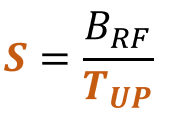
The chirp slope is determined by the RF signal bandwidth and Tup,
and when B_RF is fixed, the slope increases as T_UP decreases.
 |
2. Design Consideration
The maximum beat frequency must satisfy the ADC constraint:
|
, B_BB is baseband signal bandwidth |

3. Example
Given Conditions
| Items | Parameter | Value | Remark | |
| RF/Chirp Bandwidth | B_RF | 200 MHz | Restricted by range resolution(0.75m) | |
| ADC Sampling Rate | f_s | 2.5 MHz | Fixed by system (SoC) | |
| Nyquist Frequency | f_Nyq | 1.25 MHz | Fixed by system (SoC) |
Maximum Beat Frequency Limits
| Margin for f_nyq | No Margin | 30% Margin | 98% Margin | |
| Max Beat Frequency | 1.25 MHz | 0.375 MHz | 25.4 kHz |
T_UP Calculation for Maximum Range
| Beat Frequency Max | 1.25 MHz | 0.375 MHz = | 25.4 kHz | |
| T_UP @ Max range 8 m | 8.53 µs | 28.4 µs | 420 µs | |
| T_UP @ Max range 150m | 160 µs | 533.3 µs | 7.88 ms |


Radar Sensor SoC & Module

WiFi IoT Module

5G/LTE/CAT-M1/NB-IoT

WiSUN/HaLow/Thread Module
