
Doppler Effect → Velocity
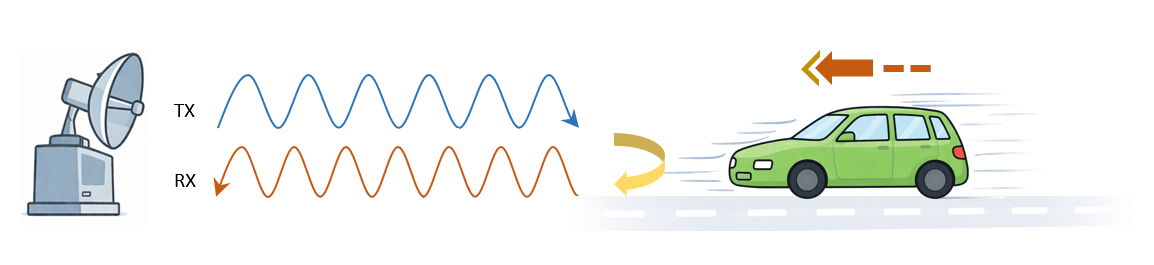
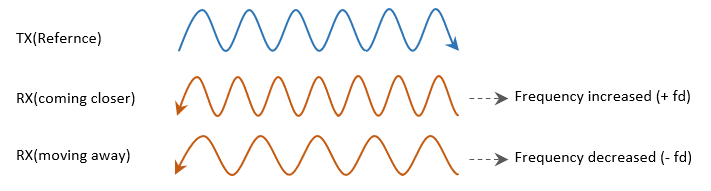
Reflected waves from a moving object experience a change in received frequency (Doppler Effect).
As the object comes closer, the frequency increases; as it moves away, the frequency decreases.
This frequency shift (Doppler shift) can be used to calculate the velocity.
|
|
|||
Doppler Effect in FMCW
In FMCW radar, the transmitted and received signals are mixed to generate a beat frequency using a mixer.
If the target is moving, this beat frequency contains both the range component and the Doppler-induced frequency shift.
Assuming that the Doppler shift(fd) in the beat frequency can be separated and known, we can calculate the velocity.
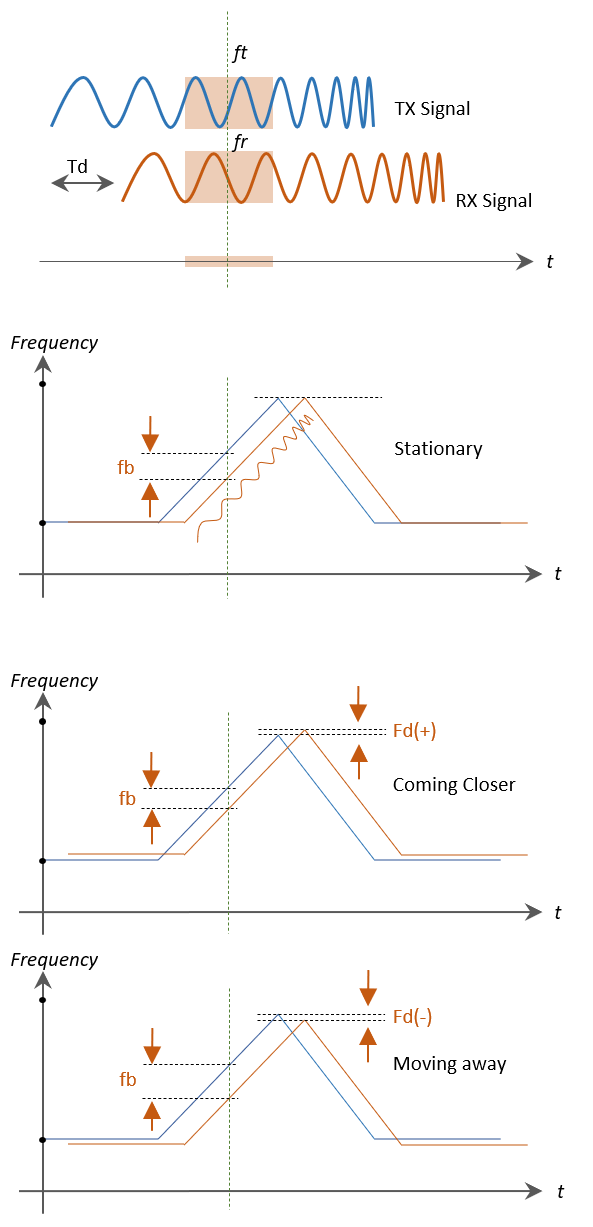
The method for measuring the beat frequency is described in the “Mixer” section.
The method for separating the components caused by propagation delay and the Doppler effect from the measured beat frequency
is explained in the “How to Measure” section.

Radar Sensor SoC & Module

WiFi IoT Module

5G/LTE/CAT-M1/NB-IoT

WiSUN/HaLow/Thread Module
